NACS vs. J1772: Differences, Compatibility, and EV Charging Adapters
Published: 19 Oct 2026
Choosing between NACS and J1772 can affect which charging stations your electric vehicle can use, whether you need an adapter, and how easily you can charge at home. Although both connectors support AC charging, they differ in design, vehicle compatibility, and their role in DC fast charging. The right choice depends on your vehicle’s charging inlet, the connector attached to the charging station, and the type of charging you plan to do.
NACS, originally developed by Tesla and now standardized as SAE J3400, is being adopted by more automakers in North America. J1772 remains common on many existing Level 1 and Level 2 charging stations. Understanding how the two standards differ helps you check compatibility before plugging in or buying new equipment. If you are unfamiliar with the wider range of plugs used by electric vehicles, our guide to EV charging connector types and their uses provides the broader picture.
This guide compares NACS and J1772, explains how their charging capabilities differ, and shows when an adapter may be needed for home charging or public stations.
Table of Contents
Key Takeaways
- NACS and J1772 serve different connector standards: Both support AC charging, but their physical designs and vehicle compatibility differ.
- Charging speed depends on more than the connector: The vehicle’s onboard charger, electrical supply, and charging station determine AC charging speed. DC fast charging depends on compatible vehicle and station equipment.
- Adapters can bridge some compatibility gaps: The correct adapter depends on the vehicle’s charging inlet, the station’s connector, and whether you are using AC or DC charging.
- J1772 remains useful for home charging: Many existing Level 2 home chargers use J1772 connectors, and compatible adapters can allow some NACS-equipped vehicles to use them.
- Check compatibility before charging: Confirm the vehicle manufacturer’s guidance and the adapter’s approved use before connecting your EV to a different charging standard.
NACS vs J1772: Quick Answer
NACS and J1772 are EV charging connector standards used in North America. NACS, originally developed by Tesla and standardized as SAE J3400, uses a compact connector for both AC charging and DC fast charging. J1772, also called Type 1, is widely used for AC charging, including Level 1 and Level 2 home charging. DC fast charging for vehicles with a J1772 inlet typically uses a separate connector standard, CCS1.
The main difference is connector design and charging compatibility. A vehicle with a NACS inlet cannot automatically connect to every J1772 charger, and a J1772-equipped vehicle cannot use every NACS charging station without the appropriate adapter and support.
| Feature | NACS | J1772 |
| Common name | Tesla connector, standardized as SAE J3400 | Type 1 |
| AC charging | Yes | Yes |
| DC fast charging | Supported with compatible vehicle and station equipment | Uses a separate CCS1 connector for DC fast charging |
| Physical design | Compact connector with five main contacts | Larger AC connector with five main contacts |
| Home charging | Available through NACS-compatible equipment | Common on existing Level 1 and Level 2 chargers |
| Adapter needs | May need an adapter to use a J1772 charging cable | May need an adapter to use a NACS charging cable |
| Compatibility | Depends on the vehicle, charger, adapter, and network access | Depends on the vehicle, charger, adapter, and charging type |
For home charging, the connector alone does not determine how quickly an EV charges. The vehicle’s onboard charger and the available electrical supply also matter. Before buying a charger or adapter, check the vehicle manufacturer’s compatibility guidance and confirm that the equipment supports the charging type you intend to use.
What Are NACS and J1772 Charging Connectors?
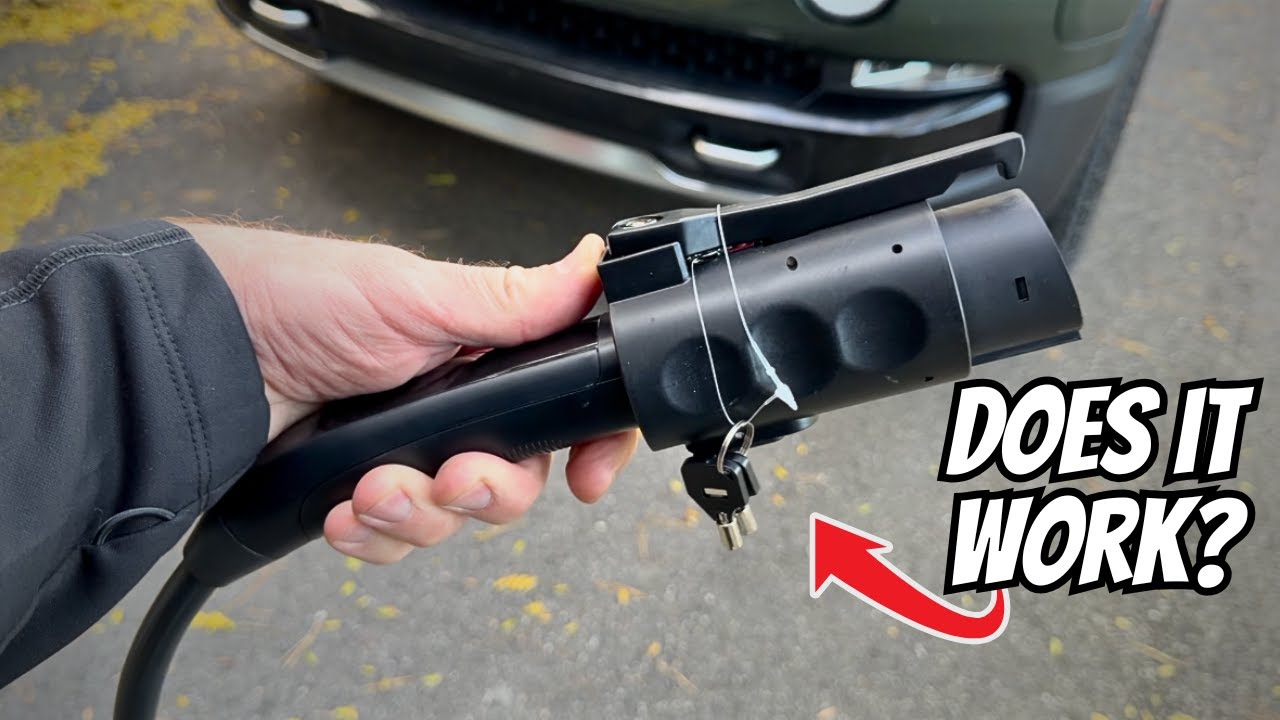
NACS and J1772 are two connector standards used to connect electric vehicles to charging equipment in North America. Both carry power to an EV, but they differ in physical design, charging capabilities, and compatibility with vehicles and charging stations.
What Is NACS (North American Charging Standard)?
NACS is a charging connector design originally developed by Tesla. It uses one compact connector for AC charging and DC fast charging, rather than requiring a separate vehicle inlet for each charging type. Tesla opened its connector design for wider adoption in 2022, and the Society of Automotive Engineers later standardized it as SAE J3400.
The connector is used by Tesla vehicles and is being adopted by other automakers for compatible North American models. However, a vehicle having a NACS inlet does not automatically guarantee access to every charging network. Vehicle support, station compatibility, network access, and any required adapter still matter.
What Is SAE J1772?
SAE J1772 is a standard for conductive AC charging, commonly known as Type 1. Its connector is widely used by non-Tesla electric vehicles and Level 1 and Level 2 charging equipment in North America.
J1772 supports AC charging, with the vehicle’s onboard charger converting incoming AC power into the DC power stored in the battery. For DC fast charging, vehicles using a J1772-based charging inlet typically use the larger CCS1 connector, which combines the J1772 AC contacts with additional DC power contacts.
Many existing home charging stations use a J1772 plug. Drivers with compatible NACS-equipped vehicles may be able to use these chargers with an appropriate adapter approved for their vehicle and charging setup.
Is NACS the Same as J1772?
No. NACS and J1772 have different connector shapes and physical interfaces, so their plugs are not directly interchangeable. Both support AC charging, but their approach to DC fast charging differs: NACS supports AC and DC through the same connector design, while J1772 is used for AC and typically pairs with CCS1 for DC fast charging.
Adapters can make certain combinations work, but compatibility depends on the direction of the connection, charging type, vehicle, station, and adapter specifications. An adapter designed for AC charging should not be assumed to support DC fast charging.
What Is SAE J3400 and How Does It Relate to NACS?
SAE J3400 is the technical standard that formalizes the North American Charging System connector. NACS is the familiar name for the design, while SAE J3400 is the standardized designation used in technical and industry documentation.
The distinction matters when checking vehicle specifications, charger documentation, or adapter compatibility. A product described as NACS-compatible should still be checked against the relevant SAE J3400 requirements and the vehicle manufacturer’s instructions. The name alone does not establish that a charger or adapter supports every vehicle or charging mode.
NACS vs J1772: Key Differences
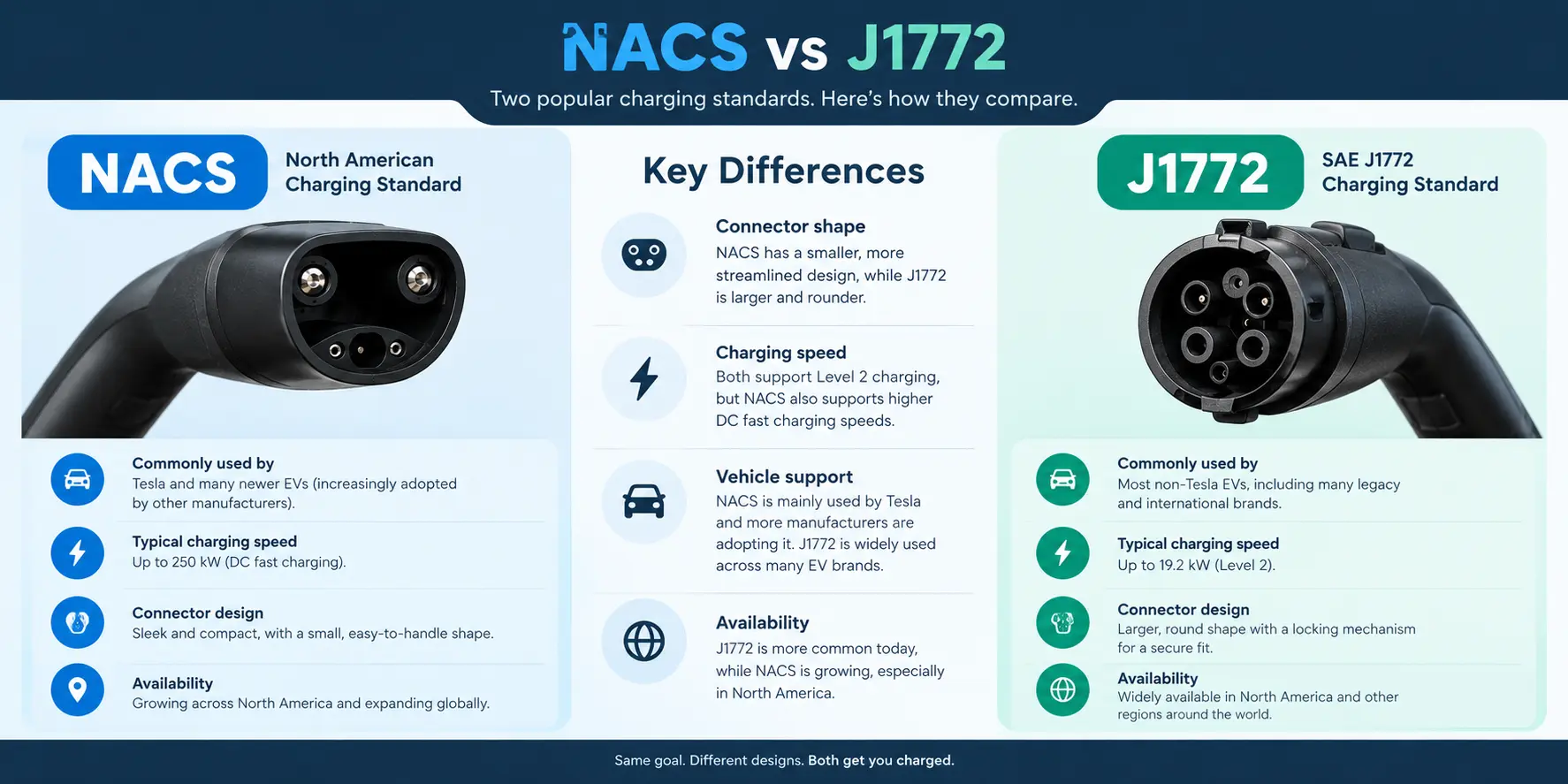
NACS and J1772 differ in connector size, charging capabilities, and compatibility with EV charging equipment. The most important distinction is that NACS supports AC charging and DC fast charging through the same vehicle inlet, while J1772 is designed for AC charging and typically relies on CCS1 for DC fast charging.
Connector Shape and Physical Design
NACS has a compact, rounded connector with a smaller overall profile. Its design supports both AC and DC charging, making it suitable for home charging and compatible DC fast charging stations.
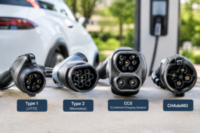
J1772 has a larger connector body with a different arrangement of contacts. It is widely used for AC charging at homes, workplaces, and public charging locations. Its physical design is distinct from NACS, so the plugs cannot connect directly without compatible adapter equipment.
The difference in size does not determine charging performance by itself. Charging speed depends on the vehicle, power supply, charger capabilities, and charging conditions.
Charging Port and Pin Layout
NACS and J1772 use different physical interfaces and contact arrangements. Both include power contacts and communication functions that allow the vehicle and charging equipment to coordinate charging safely.
NACS uses five main contacts to support AC charging, DC power delivery, and communication. J1772 also has five main contacts, but its interface is designed for AC charging. Vehicles that use CCS1 for DC fast charging have two additional large DC power contacts below the J1772-style portion of the inlet.
This distinction explains why connector shape alone is not enough to determine compatibility. The vehicle inlet, station plug, adapter design, and supported charging mode must all match.
AC Charging and DC Fast Charging
AC charging supplies alternating current to the vehicle. The EV’s onboard charger converts that electricity into direct current for the battery. Both NACS and J1772 support AC charging, including common Level 2 home charging setups.
DC fast charging works differently. The charging station converts AC electricity to DC before delivering it to the vehicle’s battery system. NACS supports DC fast charging through its existing connector design when the vehicle and station are equipped for it.
J1772 itself is an AC charging standard. A vehicle using a J1772-based inlet typically needs a CCS1 connection for DC fast charging. This is why some vehicles have a combined CCS1 inlet, while NACS-equipped vehicles can use the same inlet design for AC and DC charging.
Charging Speed and Power Limits
Neither connector guarantees a particular charging speed. The actual rate depends on several factors, including the vehicle’s maximum AC charging capacity, the charging station’s power output, the available electrical supply, battery temperature, and battery state of charge.
For home charging, a Level 2 NACS charger is not automatically faster than a Level 2 J1772 charger. If both deliver power within the vehicle’s supported AC charging limit, charging performance may be similar.
DC fast charging can deliver much higher power, but the vehicle must support the station’s charging standard and the required adapter, if one is used. Always check the vehicle specifications and charging equipment ratings rather than choosing based on the connector name alone.
Compatibility With EVs and Charging Stations
Compatibility depends on the connector at the vehicle, the plug attached to the charging station, and the type of charging being used. Some vehicles can use a different connector through an approved adapter, while others may have restrictions based on model year, charging network, or charging mode.
For example, a NACS-equipped EV may be able to use a J1772 home charger with a compatible AC adapter. A J1772-equipped EV may use a supported NACS AC charging source with the appropriate adapter. DC fast charging requires separate confirmation because an AC adapter cannot be assumed to support DC power.
Before connecting an EV, check the vehicle manufacturer’s instructions, the charger’s specifications, and the adapter’s approved use. Physical fit alone does not prove that a charging combination is safe or supported.
NACS vs J1772 vs CCS1: Understanding the Differences
NACS and J1772 support AC charging, but their roles differ from CCS1. NACS supports AC and DC charging through one connector design, while J1772 provides AC charging and combines with additional DC contacts in a CCS1 inlet for fast charging.
| Connector | Main use | AC charging | DC fast charging |
| NACS | Home, workplace, and public charging | Yes | Yes, with compatible equipment |
| J1772 | Level 1 and Level 2 charging | Yes | No, not through J1772 alone |
| CCS1 | DC fast charging and AC charging through a combined inlet | Yes, through its J1772 portion | Yes |
For home charging, J1772 remains useful because many existing Level 2 chargers use this connector. CCS1 matters mainly when checking public DC fast charging compatibility. NACS adoption is changing the connector options available to drivers, but compatibility still depends on the vehicle, charging station, and any required adapter.
NACS and J1772 Adapter Compatibility
An adapter can allow an EV to connect to a charging station with a different connector, but it must support the vehicle, charging type, and direction of connection.
What Is a J1772-to-NACS Adapter?
A J1772-to-NACS adapter allows a compatible NACS-equipped vehicle to connect to a charging cable with a J1772 plug. It is commonly used when a home or public Level 2 charger has a J1772 connector.
What Is a NACS-to-J1772 Adapter?
A NACS-to-J1772 adapter allows a compatible J1772-equipped vehicle to connect to a supported NACS AC charging source. The adapter must be designed for that direction of use and approved for the vehicle and charger.
These adapters are not automatically interchangeable. An adapter for AC charging cannot be assumed to work with a DC fast charger.
How to Check Adapter Compatibility
Before buying an adapter, check the vehicle manufacturer’s guidance and confirm these details:
- The vehicle’s charging inlet and model year.
- Whether the station supplies AC power or DC fast charging.
- The adapter’s supported charging type and power rating.
- Any manufacturer restrictions or charging network requirements.
A connector that physically fits is not necessarily electrically compatible.
NACS vs J1772 for Home EV Charging
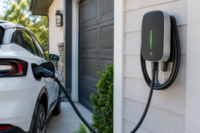
Both NACS and J1772 can support Level 2 home charging. The right setup depends on the vehicle’s inlet, the charger’s connector, and the charging power your vehicle can accept.
Can You Use a J1772 Home Charger With a NACS EV?
Often, yes. A compatible NACS-equipped EV can use a J1772 home charger with an appropriate AC adapter, provided the vehicle manufacturer permits that setup. Check the adapter rating and ensure the charging equipment is suitable for your vehicle.
Do You Need to Replace Your Existing Home Charger?
Not necessarily. If your current J1772 charger meets your vehicle’s charging needs, a compatible adapter may be enough when switching to a NACS-equipped EV. Replacing the charger may make sense if the equipment is damaged, lacks the required features, or does not suit your future charging needs.
If you are comparing equipment for a new installation, see our guide to choosing a Level 2 EV charger for home use.
What About a Household With Multiple EVs?
If you own EVs with different inlets, check whether your charging setup can serve each vehicle through its own connector or a manufacturer-approved adapter. Do not assume that one adapter will work with every vehicle or charging mode.
NACS Adoption and the Future of J1772
More automakers are adopting NACS for North American vehicles, increasing the importance of checking connector compatibility when buying an EV or planning home charging.
However, existing J1772 chargers remain useful for many current vehicles. Owners do not need to replace working equipment solely because NACS adoption is increasing. Compatible adapters can help bridge some differences between older charging equipment and newer vehicles.
The transition will take time, and available charging options will vary by vehicle, model year, charging network, and location. Check the specifications for the particular EV rather than assuming every new model supports the same charging connections.
NACS and J1772 Adapter Safety
Use only adapters that are rated for the intended charging type and compatible with your vehicle and charging equipment. Follow the vehicle manufacturer’s instructions, and never force a plug into an inlet.
Before charging, inspect the connector and adapter for cracks, damaged contacts, loose parts, or signs of overheating. Stop using the equipment if you notice burning smells, unusual heat, discoloration, or repeated charging interruptions. Do not attempt to repair damaged charging contacts yourself.
Adapters also need suitable electrical ratings and protection for their intended use. An adapter designed for AC charging must not be used for DC fast charging unless it is specifically designed and approved for that application.
Frequently Asked Questions
Is NACS better than J1772?
Neither is automatically better for every EV owner. NACS supports AC and DC charging through one connector design, while J1772 remains widely used for AC charging. The better option depends on your vehicle and the charging equipment available to you.
Is NACS the same as SAE J3400?
NACS is the commonly used name for the connector design originally developed by Tesla. SAE J3400 is the technical standard that formalizes it.
Can a Tesla charge with a J1772 charger?
Yes, compatible Tesla vehicles can use many J1772 AC charging stations with the appropriate adapter. Check the vehicle’s instructions and the charger’s specifications before use.
Can a non-Tesla EV charge at a NACS station?
Some non-Tesla EVs can use supported NACS charging stations, but compatibility depends on the vehicle, station, charging network, and whether an approved adapter is required. Not every NACS station is available to every EV.
Does NACS support Level 1 and Level 2 charging?
NACS supports AC charging, which can be used for Level 1 or Level 2 charging when the vehicle and equipment support the relevant power supply and connection.
Will J1772 charging stations become obsolete?
Not immediately. Many existing home and public AC chargers use J1772, and compatible vehicles can continue using them. The availability of new equipment may change as automakers adopt NACS, but existing chargers can remain useful for years.
Final Verdict: NACS vs J1772
NACS offers a compact connector for both AC and DC charging, while J1772 remains a common option for AC home charging. Neither connector alone determines charging speed or overall convenience. Check your vehicle’s inlet, charging requirements, and manufacturer-approved adapter options before buying a charger or connecting to a different charging standard.

- Be Respectful
- Stay Relevant
- Stay Positive
- True Feedback
- Encourage Discussion
- Avoid Spamming
- No Fake News
- Don't Copy-Paste
- No Personal Attacks
- Be Respectful
- Stay Relevant
- Stay Positive
- True Feedback
- Encourage Discussion
- Avoid Spamming
- No Fake News
- Don't Copy-Paste
- No Personal Attacks
