Can You Charge an Electric Car at Home?
Published: 14 Aug 2026
One of the biggest questions people ask before buying an electric vehicle is whether they can actually charge an electric car at home. Many first-time buyers assume they will need expensive charging equipment, major electrical upgrades, or constant access to public charging stations. Because of these concerns, some drivers delay switching to an EV even when they are interested in lower operating costs and reduced maintenance.
The reality is much simpler than most people expect.
Yes, you can charge an electric car at home, and most EV owners do exactly that. In fact, the majority of home EV charging happens overnight while the vehicle is already parked. Instead of making weekly trips to a gas station, many drivers simply plug in their vehicle before bed and wake up with enough range for the day ahead.
For many people, this becomes one of the most convenient parts of owning an electric vehicle. The vehicle gains range while sitting in the garage, driveway, or designated parking space, making everyday transportation easier to manage.
However, not every home charging situation looks the same. A homeowner with a private garage has different options than someone living in an apartment building. Likewise, a driver who travels 15 miles per day has very different charging needs than someone commuting 80 miles every day.
That is why the answer to “Can you charge an electric car at home?” is almost always yes, but the best solution depends on your lifestyle, parking situation, and driving habits.
In this guide, you’ll learn whether you can charge an EV at home, what equipment may be required, and how homeowners, renters, and apartment residents can make charging an EV at home practical.
Yes, you can charge an electric car at home. Most EVs can use a standard household outlet for slower Level 1 charging or a dedicated Level 2 home charger for faster charging. The best option depends on your daily driving, parking situation, and charging needs.
| Charging Option | Typical Use Case |
|---|---|
| Standard 120 volt outlet (Level 1) | Light daily driving and overnight charging |
| Level 2 home charger | Faster and more frequent home charging |
| Shared residential charger | Apartments, condos, and shared parking |
Your best home charging option depends on where you park, how much you drive, and how quickly you need to recharge your EV.
Table of Contents
Why Home Charging Is the Most Popular Option
When many people first research electric vehicles, they assume public charging stations will become part of their daily routine.
That is rarely the case.
Most EV owners rely on home EV charging because it is often the simplest and most convenient way to keep the battery charged. The vehicle charges while it is already parked, eliminating the need for separate refueling trips during the week.
Consider two neighbors.
One drives a gasoline SUV and stops at a gas station every weekend. The other owns an electric vehicle and spends a few seconds plugging in before going to bed. Both wake up ready for the week ahead, but only one needed to make a dedicated trip to refuel.
This convenience is one reason so many drivers choose to charge an electric car at home rather than relying on public chargers.
Home charging can also help reduce transportation costs. Many utility providers offer discounted overnight electricity rates, making charging an EV at home significantly cheaper than using many public charging stations.
Do You Need a Special Charger to Charge an Electric Car at Home?
Not always.
One of the most common misconceptions among new EV buyers is that a dedicated charging station must be installed before bringing the vehicle home.
In reality, most electric vehicles include a charging cable that allows owners to begin charging immediately using a standard household outlet. This means many drivers can charge an EV without a home charger during the early stages of ownership.
This charging method is commonly called Level 1 charging.
For drivers with short daily commutes, Level 1 charging may provide enough energy each night to support normal driving. If the vehicle remains parked overnight, the battery can often recover the energy used during the day without requiring additional equipment.
However, drivers with longer commutes frequently upgrade to a dedicated home charging station because it provides much faster charging speeds and greater flexibility.
The important thing to understand is that you do not necessarily need expensive equipment on day one. Many people successfully charge an electric car at home using the equipment included with the vehicle.
Can You Charge an Electric Car With a Regular Outlet?
A very common question from first time EV buyers is whether they can charge an electric car with a regular outlet.
In most cases, the answer is yes.
Most electric vehicles can be connected to a standard 120 volt household outlet using the charging cable provided by the manufacturer. This allows drivers to charge an EV at home without immediately purchasing additional charging equipment.
For some households, this simple solution works surprisingly well.
Imagine a driver who travels 20 to 25 miles per day and parks the vehicle for 12 hours every night. Because daily energy consumption is relatively low, a standard outlet may be capable of replacing most or all of that energy during the overnight charging window.
In this scenario, spending hundreds of dollars on charging equipment may not provide a significant benefit.
However, charging speed becomes more important as daily mileage increases. Drivers covering 60, 70, or 80 miles per day often require more energy than a standard outlet can comfortably replace overnight.
This is one reason many EV owners eventually transition to faster Level 2 charging systems.
Can You Charge an Electric Car in a Garage?
Many homeowners wonder whether they can charge an electric car in a garage.
For most people, a garage is actually the easiest place to charge an EV at home.
A garage protects from weather, convenient access to electrical outlets, and offers a dedicated parking location where charging equipment can remain permanently installed.
Whether you use a standard outlet or a Level 2 charger, a garage often provides the most practical home charging environment.
However, having a garage is not required.
Many EV owners successfully charge their vehicles in driveways, carports, and outdoor parking areas using charging equipment designed for outdoor use.
Can You Charge an Electric Car in an Apartment?
A growing number of drivers ask whether they can charge an electric car in an apartment.
The answer depends on the building and parking arrangements.
Apartment charging can be more challenging than charging in a private garage because residents often share parking facilities. However, many newer apartment communities now offer dedicated EV charging spaces or shared charging stations for residents.
Some drivers also combine apartment living with workplace charging, public charging, and occasional home charging when visiting family or friends.
As EV adoption continues to grow, apartment charging options are becoming more common across the country.
Can Renters Charge Electric Cars at Home?
Another common concern is whether renters can charge electric cars at home.
In many cases, yes.
Renters who have access to a garage, driveway, or assigned parking space may be able to use a standard outlet or request permission to install charging equipment.
The exact process depends on the property owner and local regulations.
Today, many landlords recognize the growing demand for EV charging and are increasingly open to discussions about charging solutions for tenants.
For renters considering an EV purchase, it is worth discussing charging options with the property owner before making a final decision.
Can You Charge an Electric Car Without a Garage?
One of the biggest myths about electric vehicles is that you need a garage to own one.
While having a garage can make home EV charging more convenient, it is far from a requirement. Millions of drivers park outside every day, and many of them successfully charge an electric car at home using charging equipment designed for outdoor use.
Modern charging stations are built to withstand rain, snow, heat, and other weather conditions. As long as the equipment is installed correctly and follows manufacturer guidelines, outdoor charging is generally safe and reliable.
Consider two homeowners.
The first parks inside a garage and charges overnight using a wall mounted Level 2 charger.
The second parks in a driveway and uses a weather rated charging station mounted on an exterior wall.
Both vehicles charge successfully. The only real difference is where the vehicle is parked.
For homeowners without a garage, the key questions are:
- Is there a convenient parking location?
- Can electrical power reach that location?
- Is the charging equipment rated for outdoor use?
If the answer is yes, owning an EV without a garage is usually very practical.
Can You Charge an Electric Car in a Driveway?
For many households, the driveway becomes the primary charging location.
This setup is common because it allows easy access to the home’s electrical system while avoiding the need for a garage.
A driveway charging setup may involve:
- A standard household outlet
- A dedicated Level 2 charging station
- A pedestal-mounted charger
- A wall-mounted outdoor charger
The best option depends on your home’s layout and driving habits.
For example, a homeowner who drives 20 miles per day may find a standard outlet perfectly adequate. A driver commuting 70 miles daily may benefit from a dedicated Level 2 charger that can quickly replenish the battery overnight.
The important point is that driveway charging is often just as effective as garage charging.
Can You Charge an Electric Car in an Apartment?
Many prospective EV buyers worry that apartment living automatically eliminates the possibility of owning an electric vehicle.
Fortunately, that is becoming less true every year.
The answer to, Can you charge an electric car in an apartment depends largely on the building’s parking infrastructure.
Older apartment complexes may have limited charging options, while newer developments increasingly include EV charging stations as a standard amenity.
Apartment residents typically fall into one of three categories.
Apartments With Dedicated EV Charging
This is the easiest scenario.
Residents simply park in designated charging spaces and connect their vehicles when needed.
The experience is very similar to homeowner charging, except the charging equipment is managed by the property rather than the resident.
Apartments With Assigned Parking But No Chargers
Many apartment communities provide assigned parking spaces but do not yet offer charging stations.
In some cases, residents can work with property management to explore charging installation options.
As electric vehicle adoption grows, more property owners are adding chargers to attract and retain tenants.
Apartments Without Assigned Parking
This situation is more challenging but not impossible.
Many drivers combine public charging, workplace charging, and occasional home charging opportunities to support their daily driving needs.
The right solution depends on how much you drive and how frequently you have access to charging.
Can Renters Charge Electric Cars at Home?
Another common concern is whether renters can charge electric cars at home.
The answer is often yes, although the process may require more planning than it does for homeowners.
A renter’s charging options depend on:
- Parking access
- Landlord policies
- Electrical availability
- Local regulations
For example, a renter with a private garage may be able to use Level 1 charging immediately.
Another renter with an assigned driveway space may be able to obtain permission to install a charging station.
In many areas, property owners are becoming more receptive to EV charging requests because electric vehicles continue to gain popularity.
Questions Renters Should Ask
Before purchasing an EV, renters should discuss:
- Available parking options
- Existing electrical access
- Installation permissions
- Shared charging policies
- Future charging plans for the property
These conversations can prevent surprises later and help determine the most practical charging solution.
Can You Charge an EV Without a Home Charger?
A surprising number of people ask whether they can charge an EV without a home charger.
The answer is yes.
Many drivers begin EV ownership using only the charging cable included with the vehicle.
This allows charging from a standard household outlet without purchasing a dedicated charging station.
Others rely on combinations of:
- Workplace charging
- Public charging stations
- Apartment charging facilities
- Shared residential chargers
While a dedicated charger often improves convenience, it is not always necessary.
Think of a dedicated home charger as a convenience upgrade rather than a requirement.
For some drivers, the included charging equipment is sufficient for months or even years.
Who Is a Good Candidate for Home Charging?
The vast majority of drivers can successfully charge an electric car at home, but some situations are particularly favorable.
Home charging is often ideal for people who:
- Have consistent parking access
- Drive predictable daily distances
- Park overnight for extended periods
- Want lower fueling costs
- Prefer avoiding frequent public charging visits
Even drivers without garages can often create effective charging solutions with the right planning.
The most important factor is not the type of home you live in.
It is whether your parking situation provides reliable access to electricity.
Common Concerns About Home Charging
Many first time EV buyers share similar concerns before making the switch.
They worry about charging speed, electrical requirements, installation costs, and whether their living situation will support EV ownership.
In reality, most of these concerns become much less significant once people understand their actual driving habits.
A driver traveling only 25 miles per day has very different needs than someone driving 100 miles daily.
By matching the charging solution to the driving requirement, most households discover that home charging is easier than they initially expected.
How Long Does It Take to Charge an Electric Car at Home?
One of the most common questions from prospective EV buyers is how long it actually takes to charge an electric vehicle at home.
The answer depends on several factors, including battery size, charging equipment, and daily driving habits. This is why there is no single charging time that applies to every vehicle.
A driver who uses a standard household outlet will typically experience slower charging speeds than someone using a dedicated Level 2 charger. Likewise, a compact electric vehicle with a smaller battery may recharge much faster than a larger SUV with a high-capacity battery pack.
For most drivers, however, charging time matters less than they initially think.
The reason is simple. Most EV owners do not wait for the battery to become empty before charging. Instead, they plug in at home and replace the energy used during the day.
For example, a driver who travels 30 miles per day may only need to replenish a small portion of the battery overnight. In that situation, charging becomes part of a daily routine rather than a lengthy process.
This is one reason why many people who ask, “Can you charge an electric car at home?” eventually discover that charging is easier than expected.
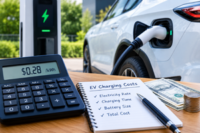
How Much Does It Cost to Charge an Electric Car at Home?
Another major concern for first-time buyers is cost.
Many people assume that charging an electric vehicle will dramatically increase their electricity bill. While home charging does add electricity usage, the cost is often lower than what drivers previously spent on gasoline.
The exact amount depends on:
- Local electricity rates
- Vehicle efficiency
- Monthly mileage
- Charging habits
Consider two drivers.
The first drives 500 miles per month.
The second drives 1,500 miles per month.
Naturally, the second driver will consume more electricity because the vehicle is covering a greater distance. However, both drivers may still spend less on energy compared with fueling a comparable gasoline vehicle.
Many utility companies also offer reduced overnight electricity rates. Charging during off peak hours can further reduce costs and make home charging even more affordable.
If you want a detailed breakdown of charging expenses, electricity usage, and cost calculations, see our guide on Cost to Charge an Electric Car at Home.
Common Challenges of Home EV Charging
Although most people can successfully charge an electric car at home, there are situations where additional planning may be required.
One common challenge involves older homes.
Some older electrical systems may not have enough available capacity to support a high-powered Level 2 charger without upgrades. In these situations, understanding EV charger installation requirements can help determine whether electrical upgrades are needed. In these situations, an electrician can evaluate the home’s electrical system and recommend appropriate solutions.
Another challenge involves parking access.
Drivers who rely on street parking may have fewer home charging options than those with dedicated parking spaces. While public charging networks can help bridge the gap, charging convenience often improves when a reliable home charging solution is available.
Apartment residents may also encounter challenges depending on their building’s infrastructure. Fortunately, more apartment communities are installing charging stations as EV adoption continues to grow.
The important thing to remember is that challenges do not necessarily mean EV ownership is impossible. They simply mean additional planning may be needed.
Common Mistakes New EV Owners Make
Many new EV owners worry about the wrong things during the buying process.
One common mistake is assuming they need the fastest charging setup available.
In reality, many households can comfortably support electric vehicle ownership using simple charging solutions. Purchasing expensive charging equipment before understanding actual driving needs can lead to unnecessary spending.
Another mistake is focusing only on maximum battery range.
While range is important, daily charging habits often matter more. A driver who charges every night may rarely use the vehicle’s full range capacity.
Some buyers also assume they cannot own an EV because they live in an apartment or rent their home. As we’ve discussed throughout this guide, apartment residents and renters often have more charging options than they realize.
The best approach is to evaluate your parking situation, driving habits, and available charging resources before making assumptions about what is required.
Frequently Asked Questions
Can I charge an electric car at home every day?
Yes. Most electric vehicle owners charge regularly at home. Daily charging is often the easiest way to keep the battery ready for normal driving.
Can you charge an EV at home without installing a charger?
Yes. Most electric vehicles include a charging cable that can be connected to a standard household outlet. This allows many drivers to begin charging immediately without installing additional equipment.
Can you charge an electric car with a regular outlet?
Yes. Most EVs support Level 1 charging through a standard 120 volt household outlet. This option works best for drivers with lower daily mileage and longer overnight parking periods.
Can you charge an electric car in an apartment?
In many cases, yes. Some apartment communities provide dedicated EV charging stations, while others offer shared charging facilities or assigned parking spaces that support charging solutions.
Can renters charge electric cars at home?
Yes. Many renters successfully charge EVs at home using existing electrical outlets, shared charging facilities, or landlord approved charging installations.
Do you need a garage to charge an electric vehicle?
No. While a garage can make charging more convenient, many EV owners successfully charge in driveways, carports, and outdoor parking spaces using weather rated charging equipment.
Is home charging cheaper than public charging?
In many cases, yes. Home charging often costs less per kilowatt hour than public charging stations, especially when using off peak electricity rates.
Is it difficult to charge an electric car at home?
For most people, no. Once the charging setup is in place, home charging is usually as simple as plugging in the vehicle when it is parked.
Key Takeaways
- Most people can charge an electric car at home regardless of whether they own or rent their property.
- Many drivers can charge an EV at home using a standard household outlet.
- A dedicated charger can improve charging speed but is not always required.
- Homeowners, renters, apartment residents, and drivers without garages may all have viable charging options.
- Home charging is often more convenient and more affordable than many prospective buyers expect.
- The best charging solution depends on parking access, driving habits, and available electrical infrastructure.
Conclusion
So, can you charge an electric car at home?
For most drivers, the answer is yes.
Whether you own a home, rent an apartment, park in a driveway, or use a garage, there is a good chance that a practical home charging solution already exists. While some situations may require additional planning, most EV owners quickly discover that charging at home is simpler than they originally imagined.
The key is understanding your daily driving needs and matching them with the right charging setup. Once that happens, charging often becomes just another part of your routine.
For a complete breakdown of charging methods, equipment, charging speeds, and setup options, read our guide on How to Charge an Electric Car at Home.



- Be Respectful
- Stay Relevant
- Stay Positive
- True Feedback
- Encourage Discussion
- Avoid Spamming
- No Fake News
- Don't Copy-Paste
- No Personal Attacks
- Be Respectful
- Stay Relevant
- Stay Positive
- True Feedback
- Encourage Discussion
- Avoid Spamming
- No Fake News
- Don't Copy-Paste
- No Personal Attacks
